
Finding a stock price is easy. Building a reliable workflow around historical prices, company financial statements, market news, and corporate actions is considerably more demanding.
Researchers and developers often spend substantial time collecting information, standardizing formats, and connecting different sources before they can begin their actual analysis.
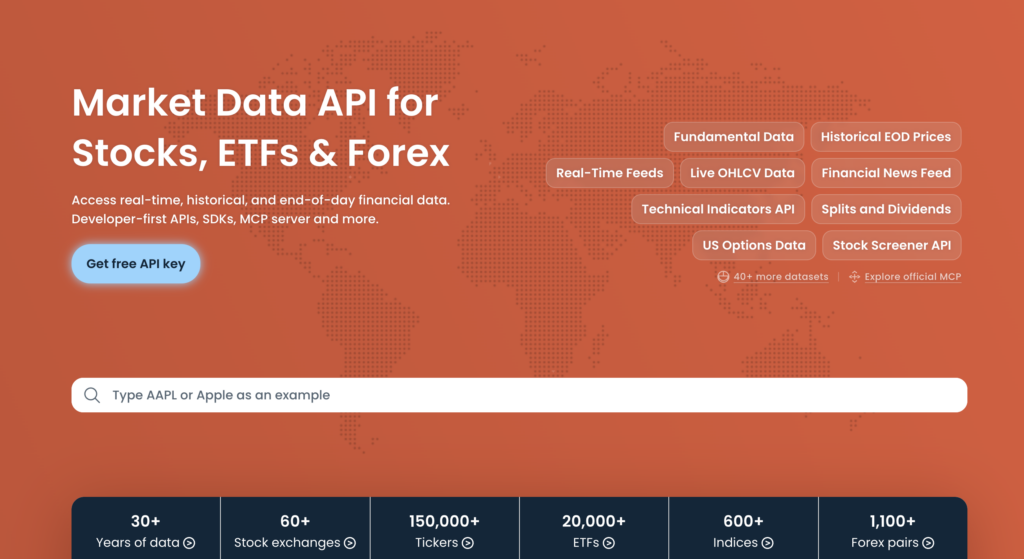
EODHD, also known as EOD Historical Data, aims to simplify that process through financial-data APIs and spreadsheet integrations.
Its main appeal is access to several financial datasets through one provider. However, choosing a financial-data service requires careful consideration of coverage, update frequency, adjustments, licensing, and data quality.
This review examines EODHD’s documented features, pricing, practical applications, strengths, and limitations to help you decide whether it fits your requirements.
Affiliate disclosure: This article contains affiliate links. If you purchase a subscription through these links, we may receive a commission.
Editorial note: This review is based on EODHD’s official documentation and pricing pages, researched on October 1, 2026. It does not claim hands-on paid-account testing or independently verified accuracy, latency, or uptime. Prices and features may change.
EODHD Review: Our Quick Verdict
EODHD is worth evaluating for historical financial research, spreadsheet analysis, and applications that need several financial datasets from a common provider.
Its strongest potential benefit is reducing the work required to collect and organize information from multiple sources.
A research workflow might need historical prices, company financials, and recent news. Accessing these datasets through related APIs can simplify integration and make the process easier to maintain.
The right choice depends on your intended use.
A personal spreadsheet has different requirements from a public financial website. A daily research model has different requirements from a system that depends on rapidly changing prices.
Our assessment is that EODHD deserves consideration when you need structured financial data and are prepared to validate the instruments and fields relevant to your project.
| Intended use | Our assessment |
|---|---|
| Historical price research | Worth shortlisting |
| Personal spreadsheet analysis | Accessible starting point |
| Company financial analysis | Test the required fields and reporting periods |
| Research dashboards | Potentially useful |
| Commercial financial applications | Confirm licensing and coverage first |
| Trading-sensitive systems | Require specific feed-suitability checks |
| Occasional stock-price lookup | A subscription may be unnecessary |
These are editorial assessments rather than benchmark results.
What Is EODHD?
EODHD is a financial-data provider offering APIs for historical prices, company fundamentals, intraday data, streaming prices, news, and other datasets.
Its documentation covers multiple asset classes, including equities, ETFs, funds, indices, currencies, and cryptocurrencies. Availability depends on the dataset, instrument, and subscription.
An API allows an application or spreadsheet to request information directly.
For example, a program can request a company’s historical prices and receive structured records that can be stored, charted, or analyzed.
This makes EODHD a potential data source for a separate research tool, dashboard, or application. You remain responsible for how the information is interpreted and presented.
How EODHD Works
A typical implementation involves four stages.
1. Identify the Data You Need
Historical prices, financial statements, intraday bars, and news support different tasks.
Start with a specific requirement, such as comparing historical returns or examining quarterly company performance.
2. Choose the Appropriate Subscription and License
Confirm that the plan includes the required endpoints and that its license fits your intended use.
Technical access and commercial permission are separate considerations.
3. Retrieve the Information
Use an API request, supported integration, or spreadsheet add-on to retrieve the data.
4. Validate and Analyze the Results
Check symbols, currencies, dates, missing values, and adjustment conventions before relying on the results.
Starting with a small instrument list makes the evaluation easier. Expand after the initial workflow meets your requirements.
EODHD Features Explained
End-of-Day Historical Prices
The end-of-day API returns daily open, high, low, close, adjusted close, and volume. It supports date filtering and weekly or monthly aggregation.
Instrument identifiers generally combine a symbol and exchange code, such as AAPL.US or SAP.XETRA.
Historical depth varies by instrument, so confirm the actual start date for the securities you need.
This dataset can support:
- Historical charting.
- Return comparisons.
- Longer-term trend research.
- Portfolio analysis.
- Research-model development.
Consistency is essential. Decide which price series your calculations require before combining records.
Adjusted Prices and Corporate Actions
EODHD’s documentation distinguishes raw OHLC prices from adjusted close.
Adjusted close accounts for splits and dividends, while the documented volume series is split-adjusted.
This matters when analyzing historical performance. A split can create a substantial change in the raw share price without representing an equivalent economic loss.
Your calculations need to account for that behavior.
Preserve the retrieval date and adjustment assumptions used in each research project. Historical adjusted values can change as later corporate actions affect the series.
Fundamental Company Data
The fundamentals API provides information for stocks, ETFs, mutual funds, and indices. The available sections depend on the instrument type.
For companies, the documented financial sections include:
- Income statements.
- Balance sheets.
- Cash-flow statements.
The feed uses JSON, with filters for retrieving individual sections or fields.
This can support comparisons of revenue, profitability, leverage, and cash generation.
Before building a model, check reporting currencies, fiscal periods, missing values, and field definitions.
A missing figure should remain distinguishable from a reported zero. Treating both as the same value can materially change an analysis.
Intraday Historical Data
The intraday API provides OHLCV bars within the trading day, with intervals ranging from one minute to one hour.
This offers a more detailed view of price and volume behavior than daily data.
Potential applications include studying session patterns, short-term volatility, and intraday market behavior.
Check historical depth for the specific interval and instrument you intend to use.
Time handling also requires attention. Store timestamps consistently and convert them deliberately when displaying results.
Streaming Data Through WebSockets
EODHD documents WebSocket feeds for supported stock, forex, and cryptocurrency markets.
Streaming allows an application to receive updates without repeatedly requesting every new value.
The documentation describes a default allowance of 50 symbol subscriptions across the token’s active streams. Separate trade and quote subscriptions can consume separate slots.
Count the actual streams your application requires rather than assuming a watchlist’s number of companies equals the number of subscriptions consumed.
A streaming application should also handle reconnections and indicate when its displayed information is stale.
The availability of streaming data does not automatically establish suitability for every trading or execution requirement.
Technical Indicators
EODHD provides a technical-indicator API with documented functions including moving averages, RSI, volatility, and MACD.
Precalculated indicators can reduce implementation work when the same measures are needed across many instruments.
However, values can differ between services because of calculation settings.
Check the period, input series, adjustment method, and date range before comparing results.
If your research depends on a particular convention, verify it using a small sample before expanding the workflow.
Financial News and Sentiment
The news offering includes a financial-news feed, sentiment information, and news word weights.
The documented feed supports filtering by ticker or topic, along with date filtering and pagination.
This can add context to company-monitoring workflows and research dashboards.
Sentiment is a derived measure. It summarizes how a model interprets text and does not establish the financial significance of the underlying event.
Consider publication times, relevance, duplicated coverage, and the original article when using this information.
Google Sheets and Excel Integrations
EODHD’s spreadsheet tools provide an entry point for users who prefer working with tables instead of building a custom application.
Its Google Sheets documentation describes access to historical and fundamental information, indicators, and other functionality through an add-on. Access depends on the API key and data entitlements.
A practical spreadsheet might contain:
| Field | Purpose |
|---|---|
| Company and symbol | Identify the instrument |
| Price date | Show the value’s freshness |
| Selected price | Track the required measure |
| Reporting period | Identify the financial statement |
| Currency | Prevent currency confusion |
| Financial metrics | Support comparison |
The benefit is combining retrieved information with your own formulas and notes.
Spreadsheet access makes retrieval more approachable, but understanding the data remains essential.
EODHD API Review
A documented historical-price request follows this structure:
GET /api/eod/AAPL.USThe request supplies an API token and can specify JSON or CSV output.
The fundamentals documentation recommends the versioned v1.1 endpoint for new integrations.
Initial experimentation can be relatively straightforward. Production use requires more deliberate handling of data behavior.
A dependable integration should:
- Validate instrument identifiers.
- Handle unsuccessful requests.
- Distinguish empty responses from unavailable coverage.
- Record retrieval timestamps.
- Track usage.
- Cache data appropriately.
- Keep API credentials out of public code.
Separate retrieval from analysis. Preserve the original response or a clearly defined normalized version before performing calculations.
This makes it easier to determine whether an unexpected result came from the source information, transformation, or model.
EODHD Pricing
The following personal-plan prices were displayed when researched:
| Personal plan | Monthly billing | Annual billing |
|---|---|---|
| Free Package | $0 | $0 |
| EOD Historical All-World | $19.99 | $199.00 |
| EOD + Intraday All-World Extended | $29.99 | $299.90 |
| Fundamentals Data Feed | $59.99 | $599.90 |
| ALL-IN-ONE Package | $99.99 | $999.90 |
The free plan lists 20 daily API-call units. Core paid personal plans list 100,000 daily units.
Specialist marketplace products are separately identified as add-ons. The ALL-IN-ONE name should therefore not be interpreted as including every separately sold dataset.
Check EODHD’s current plans and availability before subscribing.
Choose according to your required endpoints rather than assuming the largest package is automatically the best fit.
Commercial Pricing
The commercial pricing page displayed:
| Commercial plan | Monthly billing | Annual billing |
|---|---|---|
| Internal use | $399.00 | $3,990.00 |
| Enterprise | $2,499.00 | $24,990.00 |
| Custom | From $399.00 | Request a quote |
Commercial plans distinguish internal use, delivery capabilities, seats, and support arrangements.
Confirm the terms relevant to your project directly with the provider.
For a business, licensing can affect the total cost more than the personal-plan headline price.
API Limits: Requests and Calls Are Different
EODHD distinguishes an HTTP request from the API-call units that request consumes.
Different endpoints have different costs. Its documentation also separates the per-minute request limit, daily call allowance, and marketplace quotas.
This affects capacity planning.
Estimate usage from the endpoints and refresh schedule your application actually needs:
Expected daily usage = records requested × refresh frequency × endpoint cost.
Include initial downloads, retries, and bulk operations.
A watchlist refreshed once a day has a different workload from an application repeatedly fetching several datasets for every user.
Measure actual consumption during evaluation instead of assuming every request costs one unit.
Personal vs. Commercial Licensing
EODHD’s licensing documentation distinguishes personal use from commercial use.
Confirm the applicable license if you plan to build:
- A public financial website.
- A paid dashboard.
- A customer-facing application.
- An internal company analytics tool.
- A product that redistributes data.
Explain the intended use to the provider and obtain clarity about the relevant rights.
Access to an API does not automatically provide permission for every type of storage, public display, or redistribution.
For a commercial project, resolve licensing before designing the product around a particular subscription.
Data Quality and Provenance
Data quality includes completeness, timestamps, corporate-action handling, reporting conventions, and source information.
EODHD’s data-sources page describes exchange and data-partner arrangements for certain feeds. It also says some EOD and delayed information comes from market makers and CFDs, while fundamentals are collected from filings and other published sources.
There is an inconsistency in its public information: the general pricing-page disclaimer describes pricing feeds more broadly as non-exchange, indicative information and cautions about trading suitability.
Because those statements differ, projects with strict provenance requirements should request clarification for the exact endpoint, market, and instrument.
This review cannot resolve that inconsistency or independently certify the feeds.
A practical evaluation should compare representative records with suitable references and investigate discrepancies.
Test several types of instruments rather than relying on a single large-company example.
Who Is EODHD Best For?
Independent Researchers
Researchers can evaluate EODHD for historical series and company information.
The potential benefit is reducing manual collection while preserving control over the analysis.
Keep retrieval dates, definitions, and model assumptions clearly documented.
Spreadsheet Users
Spreadsheet users can begin with a personal watchlist or a small comparison table.
This is an approachable way to determine whether the required fields and coverage meet their needs.
Developers
Developers can evaluate EODHD for applications requiring structured financial information.
The important considerations are endpoint behavior, completeness, usage limits, licensing, and maintainability.
Financial Publishers
Publishers may find structured information useful for preparing research tables and charts.
Confirm the applicable license and attribution requirements before displaying retrieved information publicly.
Commercial Product Teams
Product teams should evaluate technical suitability and licensing together.
A working prototype does not establish that the same information can be used under the same terms in a public or paid product.
EODHD Pros and Cons
Main Advantages
Several financial-data categories
A common provider can simplify workflows combining prices, company financials, and news.
Multiple access routes
APIs and spreadsheet integrations provide different starting points.
Focused personal subscriptions
Users can evaluate a package around their main research requirement.
Detailed documentation
The documentation explains symbols, parameters, adjustments, and usage behavior.
Main Limitations
Coverage needs instrument-level verification
Broad coverage does not establish that every required field exists for every security.
Commercial licensing changes the cost
Business use can cost substantially more than personal research access.
Some datasets are separate purchases
Review marketplace entitlements before subscribing.
Validation remains necessary
Structured delivery does not eliminate missing values, revisions, or interpretation issues.
Feed provenance needs specific clarification
Strict source requirements should be confirmed for the exact dataset.
Is EODHD Worth the Money?
EODHD’s value depends on how much useful work it enables and how much manual collection it removes.
A practical evaluation should consider:
- The datasets you actually need.
- Coverage of your instrument list.
- Time saved collecting information.
- Integration and maintenance effort.
- Subscription and licensing costs.
- Additional validation requirements.
If the service supplies the required fields consistently and fits your workflow, the subscription may be worthwhile.
If important instruments or fields are unavailable, a broad feature list will not compensate for that gap.
Choose based on verified requirements rather than the size of the advertised catalog.
How to Evaluate EODHD Before Subscribing
Start with one defined workflow.
- Select the markets and instruments you actually need.
- Identify the required datasets and fields.
- Test representative responses using permitted access.
- Check dates, currencies, adjustments, and missing values.
- Compare samples with appropriate references.
- Measure usage and integration effort.
- Confirm the intended-use license.
- Choose the smallest plan that meets the verified requirements.
The strongest evidence is that your project works reliably with the information—not simply that an API returns a response.
Frequently Asked Questions
What is EODHD used for?
EODHD supplies financial information for spreadsheets, research workflows, dashboards, and applications.
Can beginners use EODHD?
Spreadsheet integrations offer a starting point for users who do not want to build a custom application. Understanding the information remains important.
Is EODHD free?
A limited free package is listed. Broader access requires an appropriate subscription, and some specialist datasets are sold separately.
Does the ALL-IN-ONE plan include every dataset?
Marketplace add-ons are separately listed. Check the exact entitlements before purchasing.
Is all EODHD information real-time?
No. End-of-day, intraday historical, delayed, and streaming products have different update behavior.
Can I use a personal subscription for a commercial website?
Confirm the appropriate license with the provider. EODHD distinguishes personal access from commercial use.
Does EODHD guarantee profitable trading results?
Financial information does not establish that a strategy will be profitable. Data suitability, model assumptions, and results require separate evaluation.
Final Verdict: Should You Try EODHD?
EODHD offers a broad set of financial-data tools with several practical access routes.
It deserves consideration for historical research, spreadsheet analysis, and projects that combine prices with company information.
The strongest reason to subscribe is a successful test of your own requirements: the instruments are covered, the fields are usable, integration is manageable, and the license fits the project.
Commercial applications and trading-sensitive systems need additional clarity about rights and feed suitability.
Begin with a small, representative evaluation and expand when the results justify it.